


Exploring Life Insurance for Seniors over 75
Underwritten by United of Omaha Life Insurance Company



You may still have meaningful options for buying life insurance as a senior over 75, but coverage choices can become more limited with age. Guaranteed whole life insurance offers guaranteed approval for ages 45-85 (50-75 in NY), fixed premiums and permanent coverage to help protect your family from unexpected final expenses.
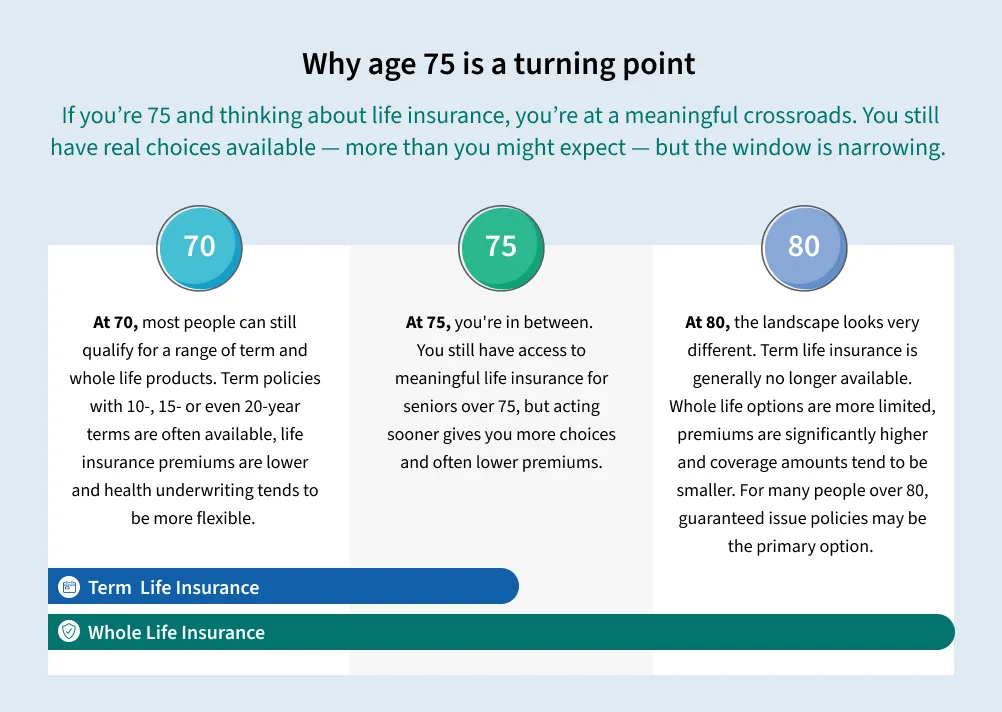
This guide explains what’s available, how to size your coverage, how buying life insurance for seniors over 75 compares with buying at 70 or 80 and what to expect when applying.
In this article:
Understanding Life Insurance at a Glance
Permanent Insurance Options at 75
I’m Over 75: Do I Want Term or Whole Life Insurance?
Calculating How Much Life Insurance You Need at 75
Keeping Payments Manageable at 75+
Understanding life insurance at a glance
Life insurance is a contract made with life insurance companies that pays a cash benefit, also known as a “death benefit,” to the beneficiary you choose. It can help cover funeral expenses and burial costs, medical bills, debts and short-term income needs. It’s also an option for seniors looking to fund gifts for loved ones or charities you care about.
When buying life insurance at ages 75 and up, two categories may be an option for seniors: term and permanent.
-

Term life insurance
Term Life Insurance coverage lasts for a predetermined period, such as 10, 15, 20 or 30 years. Term life insurance rates are often designed for individuals looking for salary replacement to help cover life expenses and for younger families.
-

Permanent life insurance
Permanent Life Insurance (or “whole life insurance”) is designed to last for a whole lifetime if structured correctly.
-

Universal life insurance
Universal Life Insurance is another form of permanent coverage. This coverage is designed with flexibility to adjust your premium and death benefit amount over time while accumulating cash value on a tax-deferred basis.
To explore in more detail how to shop for senior life insurance for seniors at a range of ages, read our article “Life Insurance for Seniors: A Practical Guide”.
Permanent insurance options at 75: Choosing between simplified issue and guaranteed issue
Whole life insurance is commonly issued in two formats: simplified issue and guaranteed issue. At 75, many applicants qualify for simplified issue whole life coverage, while guaranteed issue remains an option if health conditions or health status would make it difficult to qualify. These are the most common paths for life insurance for seniors over 75.
Here are the main distinctions between simplified and guaranteed issue whole life insurance:
Simplified issue whole life: No medical exam is required by life insurance companies in most cases. Approval is based on health questions and prescription history. Policies offer lifelong coverage, predictable premiums and a guaranteed death benefit. If your health is stable and you take common maintenance medications, simplified issue may offer the right balance between coverage and pricing.
Important consideration: While simplified issue policies might offer higher coverage amounts, they may feature a graded death benefit. This is a two-year window where the policy offers a reduced payout for non-accidental death before offering the full benefit.
Guaranteed issue whole life (ages 45-85; 50-75 in NY): No health questions or exams. Most policies include a graded death benefit.
Simplified Issue
Guaranteed Issue
Answer a few health questions
No health questions
No medical exam in most cases
No medical exam
May qualify for higher coverage amounts
Typically lower coverage amounts
May provide immediate full benefits
Policies include a graded death benefit during the first two years
Explore Guaranteed Whole Life Insurance
If significant health conditions would make traditional underwriting tough, guaranteed issue provides a straightforward route to life insurance coverage.
Wondering what life insurance rates for seniors might look like after age 80?
I’m over 75: Do I want term or whole life insurance?
For a 75-year-old, the choice between term and whole life depends on what you’re trying to accomplish.
Term life makes sense if you have a specific, time-limited financial obligation, like a remaining mortgage or a debt you want covered for a set period. It offers the most coverage per premium dollar, but it expires at the end of the term. At 75, a 10-year term policy would cover you until 85. Seniors aged 75 and above might find it difficult to be approved for a term policy.
Whole life makes sense if you want permanent coverage that won’t expire, something that’s there no matter when you pass away. It’s particularly well-suited for helping to cover funeral and burial expenses, paying off small debts or simply reducing the financial burden on your family. Life insurance premiums on whole life are guaranteed not to increase, and the policy builds cash value you can access in an emergency.
For many people at 75, whole life is the more practical choice because it provides lifelong protection without the risk of outliving the policy.
Calculating how much life insurance you need at 75
Figuring out how much life insurance coverage you need doesn’t have to be complicated. To start, calculate any savings, existing insurance or other funds already set aside for these costs. Then, consider how much you’ll need for these additional considerations:
Funeral and burial costs: The median cost for funeral and burial (without a vault) in 2026 was $8,300, depending on your preferences and location, according to the 2026 NFDA Price List Study.1
Outstanding debts: You should include anything that could remain on your credit cards, auto loans and medical bills.
Other final expenses: These could include legal fees, estate costs and any remaining household bills not included in your outstanding debts.
For many people at 75, the answer falls somewhere between $5,000 and $25,000, which aligns well with the coverage amounts available through whole life insurance.
Example: If you estimate $10,000 for funeral and burial, $3,000 for medical and legal expenses, and $7,000 to supplement a spouse’s income for two years, your target coverage would be $20,000. If you already have $5,000 set aside, a $15,000 policy that accounts for burial insurance could complete the plan.
Keeping payments manageable at 75+
Life insurance for seniors can be obtained, even on a fixed budget. A small, well-aimed life insurance policy can help ensure important needs are met without putting strain on your budget. However, because life insurance premiums increase with age, choosing the right structure matters.
Consider these cost-efficiency steps:
Select a benefit that directly matches your goal and life expenses, rather than paying for more than you need.
Review whether simplified issue or guaranteed issue fits your health and budget.
Ask about level premiums that do not increase as you age.
Revisit your coverage if your financial situation changes, so the policy continues to fit your plan.
For many people seeking life insurance for seniors over 75 solutions, a focused whole life policy designed for final expenses offers a balanced approach: lifelong coverage, steady premiums and a benefit sized to meet a specific need. However, the age range for acceptance is 45 to 85 years old, and 50 to 75 in New York, so this may not apply to people who live in New York.
If you’d like to see what your whole life coverage might cost, we offer a quick, free online tool for getting a quote.

*The age range for acceptance is 45 to 85 years old, and 50 to 75 in New York, so this may not apply to people who live in New York.
A final word on life insurance at 75
While choices narrow with age, many people in their mid-70s can still secure life insurance coverage that fits a focused need and a careful budget. The best step you can take today is to explore your options and see what coverage fits your needs and budget.
Frequently asked questions (FAQs)
Is it worth getting life insurance at 75?
Yes, if you have specific financial obligations or want to make sure your family isn’t left covering funeral and final expenses out of pocket. A life insurance policy for seniors at 75 can provide some peace of mind by helping to ensure those costs are taken care of. The key is choosing a policy that matches your actual needs and budget.
What’s the average whole life insurance premium for a senior at age 75?
For a no-exam guaranteed issue whole life policy with approximately $15,000 in coverage, a 75-year-old male can expect to pay roughly $100-$150 per month, while a 75-year-old female may pay approximately $75-$110 per month. Rates vary based on the insurer, your gender and the amount of coverage you choose. We offer whole life policies with premiums that never increase, starting at less than $12 per month for $3,000 of coverage for females aged 45.
What’s the typical cost of funeral and burial services?
The median cost of a traditional funeral with burial in the U.S. is approximately $8,300, according to the NFDA.1 When you include cemetery plot fees, a headstone, a burial vault and other associated costs, the total can range from $12,000 to $15,000 or more depending on your location. Cremation with a funeral service is a less expensive alternative, with a median cost of about $6,280.
What type of life insurance is best for a senior at age 75?
For most people at 75, whole life insurance is often the best fit, especially guaranteed whole life, which requires no medical exam and provides permanent coverage that won’t expire. It’s designed to help cover funeral expenses, small debts and other final costs. If you’re in good health and need higher coverage amounts for a specific period, term life insurance may still be an option, though availability is limited at this age.
Sources
1. 2026 National Funeral Cost Index Report. Retrieved Aug. 7, 2026, from 2026 National Funeral Cost Index Report.
This material is provided for general and educational purposes only and is not intended to provide legal or tax advice. Contact your attorney or other advisor regarding your specific legal or tax situation.

Subscribe for the latest articles, financial calculators and resources
Suggested content for you in Life Insurance
-
A Guide to Life Insurance for Seniors Over 80
-
Life Insurance for Seniors - A Practical Guide
-
What to Know About Life Insurance for Seniors Over 70
-
What to Do When a Loved One Dies
-
Social Media Etiquette When Someone Dies
-
When a Parent Dies - Managing Your Grief While Supporting Your Surviving Parent
-
A Guide to Dying Well
-
Navigating Life Insurance and Divorce: A Complete Guide
-
How Life Insurance and Retirement Planning Work Together
-
Is Life Insurance Part of Your Financial Portfolio?
Explore other topics
Financial Planning Basics
5 Holiday Budgeting Tips to Help You Save MoneyFinancial Planning Basics
How to Talk About Family Finances: 5 Tips for Better Money ConversationsEating Well
Is Keto Diet Safe for Older Adults? All Categories
 Medicare
 Retirement Planning
 Business Resources
 Life Insurance
 Financial Planning
 Health & Well-Being
 Travel & Living