


Life Insurance for Seniors - A Practical Guide
Underwritten by United of Omaha Life Insurance Company



Life insurance for seniors provides essential financial protection at every stage - whether you are in your 50s reviewing existing coverage, in your 60s planning for retirement, or in your 70s and 80s securing final expense protection for loved ones. This guide explains the key differences between term and permanent life insurance, outlines how coverage needs evolve with age, and highlights options, including guaranteed issue whole life policies that require no medical exam.
Life insurance is a contract where you pay premiums to an insurance company, and in return, the company pays a cash benefit to the people you choose when you pass away. That benefit can help pay funeral and burial costs, settle debts, support a spouse or leave a meaningful legacy.
In everyday use, “seniors” usually means people in their 50s, 60s, 70s and 80s. As you move through these years, life typically changes. Priorities often shift from growing assets to protecting what you have built and making things easier for the people you love.
This guide explains how to evaluate life insurance for seniors by age, policy type and goals, along with what to expect when buying online or by phone. We will walk through term life insurance, whole life insurance and universal life insurance, and how needs change for people over 50, over 65, over 70, over 75 and over 80.
In this article:
Two Main Types of Life Insurance: Permanent and Term
How to Find the Best Life Insurance for Seniors
Why Would Seniors Ages 50 and Up Want Life Insurance?
Life Insurance for Seniors Over 50
Life Insurance for Seniors Over 65
Life Insurance for Seniors Over 70
Life Insurance for Seniors Over 75
Life Insurance for Seniors Over 80
Life Insurance Enrollment Checklist
Two main types of life insurance: Permanent and term
Generally, there are two main types of life insurance: permanent and term. We will explore more of the differences below, but an important distinction is that term coverage lasts for a predetermined period of time, while permanent insurance - including whole life insurance and an array of universal life formats - is designed to last for a whole lifetime.
-

Term life insurance for seniors
Term life insurance provides coverage for a set period, such as 10, 15, 20 or 30 years. During the term, premiums remain level, and if you pass away during that period, your beneficiaries receive the death benefit. Our term life insurance is available to adults ages 18 to 80, with coverage amounts and term lengths that vary by age.
Many of these policies can be converted to permanent coverage - within stated time and age limits - without another medical exam. Policyholders can find this particularly helpful if their health changes and they want to shift from temporary coverage to lifetime protection. Term life insurance is usually best for needs with an end date, such as covering a remaining mortgage, replacing income until retirement or meeting other time-limited obligations.
-

Permanent life insurance for seniors
Permanent life insurance is coverage that lasts for life if structured correctly. Here are a few kinds of permanent life insurance and how their definitions differ:
“Whole” life insurance, sometimes referred to as “final expense” or “burial insurance,” is characterized by level premiums.
Guaranteed whole life insurance, a form of whole life insurance, is designed for simplified, guaranteed approval.
Universal life insurance is permanent coverage that allows flexibility in policy design, such as the ability to adjust premiums and death benefits.
Continue reading for more distinctions among types of permanent life insurance.
Whole life insurance for seniors
Whole life insurance is permanent coverage that can last your entire life as long as premiums are paid in full and on time. It offers level premiums, a guaranteed death benefit and cash value that grows at a guaranteed rate. Our whole life insurance is designed to provide lifetime protection with guarantees spelled out in the policy, for adults ages 45 to 85 (50 to 75 in New York), depending on the product.
We offer whole life insurance options for seniors within specific age ranges, and some options do not require a medical exam. Certain simplified issue policies use a short health questionnaire, while guaranteed issue whole life is available to qualifying applicants in a defined senior age range with no health questions. These whole life choices can be especially useful as burial or funeral coverage, providing a predictable benefit for end-of-life costs and helping your family manage immediate bills and other obligations.
To explore your options and see how whole life coverage could fit your needs, you can review our whole life insurance choices online at United of Omaha Life Insurance Company, a Mutual of Omaha Company.
Universal life insurance for seniors
Universal life insurance is a type of permanent coverage that combines lifetime protection with flexibility. Our universal life insurance allows you to adjust premiums and death benefits within policy limits, and some designs include no-lapse guarantees that help keep coverage in force when funding requirements are met.
When you want lifelong coverage with room to adjust as needs change — such as providing for a spouse, planning a legacy or coordinating with other retirement assets, Universal life insurance can be useful. For many seniors, whole life insurance is the simpler choice for final expenses, while universal life is often suited to larger, more flexible plans that may involve estate planning or supplemental retirement strategies.
Explore Universal Life Insurance
Indexed universal life insurance for seniors
Indexed universal life insurance is a type of universal life insurance that offers flexible premiums and cash value growth potential tied, in part, to the performance of a market index.
How to find the best life insurance for seniors
Finding the best life insurance as a senior starts with clarifying your goals: Do you want to cover final expenses, protect a spouse’s lifestyle, pay off debts or leave a legacy? Next, compare policy types — beginning with term and permanent options — based on how long you need coverage and how much flexibility you want. Review health questions, age eligibility and verify whether a medical exam is required, since these factors can affect approval and premiums.
It can help to gather current policy statements, estimate your final expenses and debts, and decide on a realistic premium range that fits your long-term budget. From there, you can compare quotes, check available riders and decide whether a straightforward final expense whole life policy or a broader permanent plan such as universal life best fits your situation.
If you’re ready to see how whole life insurance could help cover final expenses and provide a guaranteed benefit for loved ones, you can explore your options online at United of Omaha Life Insurance Company, a Mutual of Omaha Company. Buying online is designed to be simple and fast for eligible products, while you can still call to speak with a licensed agent (in WA/OR: producer) if you prefer more personal guidance.
Why would seniors ages 50 and up want life insurance?
There are many reasons why individuals 50 and older would want life insurance. Some of these reasons are overlapping, including preparing for retirement, protecting a spouse, handling final expenses, paying debts, preserving savings and leaving a legacy.
And while there is some overlap, there’s often more specific needs that need to be addressed in different age ranges:
Life insurance for seniors over 50
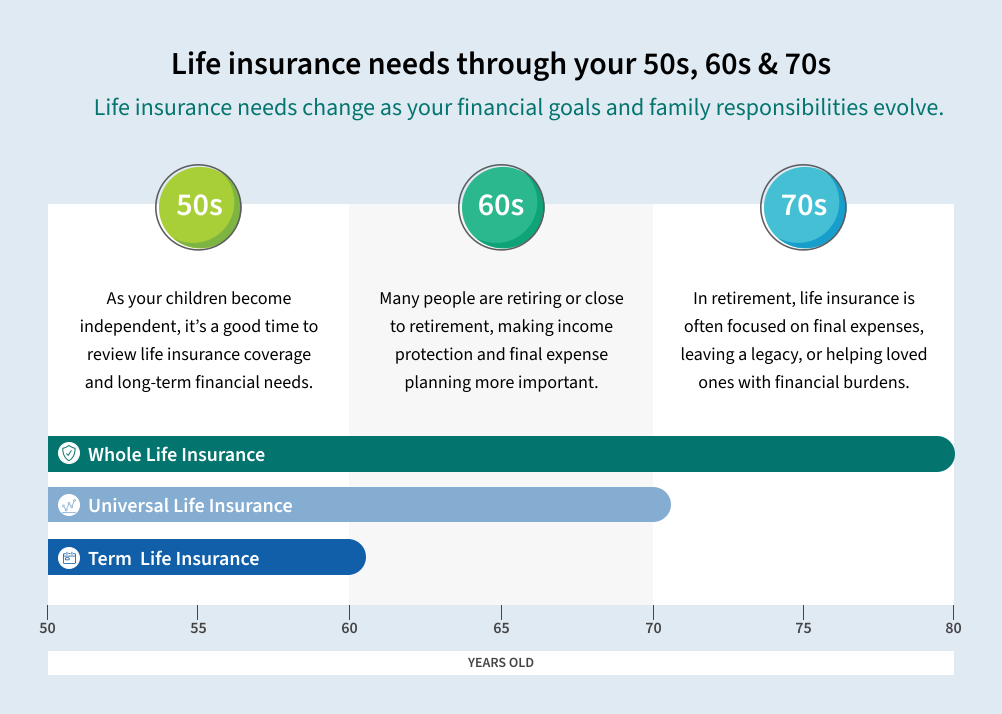
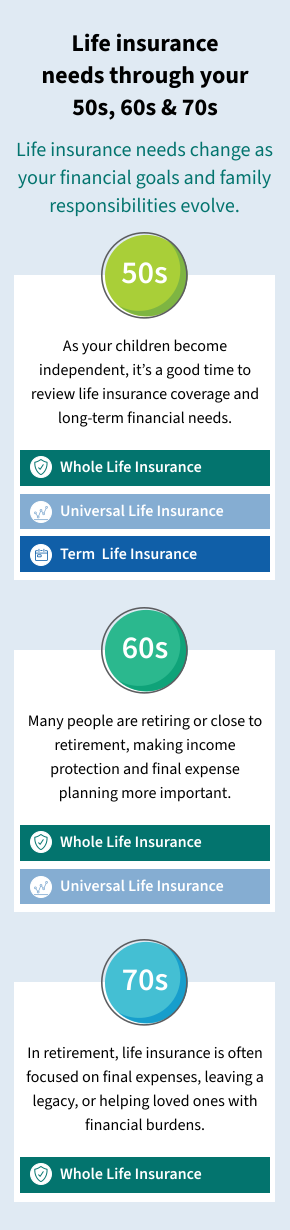
For people over 50, life insurance often supports a transition into later years. Many buyers are pre-retirement, may have children preparing for college and are starting to focus more on health considerations. At age 50 and into the 50s, policies should be reviewed, coverage amounts may need to be adjusted and term life customers may begin considering converting to permanent insurance for lifetime coverage.
During this stage of life, term life can still work well for remaining income protection or a mortgage, while whole life or universal life can start to play a role in planning for final expenses and long-term legacy goals.
Life insurance for seniors over 65
Life insurance for seniors over 65 usually centers on retirement, protecting a spouse, handling final expenses, paying debts, preserving savings or leaving a legacy. At 65, many people are either nearing retirement or going through it, deciding whether coverage is still needed and whether premiums and health qualifications still make sense.
If seniors over the age of 65 have term insurance and have not yet converted to permanent insurance, this becomes a more urgent consideration at this stage. Permanent insurance can provide lifetime protection, while remaining term coverage may be used to help cover specific debts or income gaps for a defined period.
Life insurance for seniors over 70
Seniors over 70 share many of the same life insurance needs as the over 65 range; however, for those over 70, final expenses become more of a primary focus.
For seniors over 70 who are looking for life insurance, permanent coverage becomes much more attractive. While term policies may still help with debt-related concerns, permanent policies are more focused to their needs.
Seniors over 70 are more likely to be on a fixed income, so keeping coverage aligned with the budget becomes more important, and health issues play a larger role in eligibility. Permanent options can help lock in lifetime coverage and a predictable benefit for loved ones.
Life insurance for seniors over 75
At 75, you're at a meaningful crossroads when it comes to life insurance. You still have real choices available — more than many people expect — but the window is narrowing. Every year you wait means fewer options and higher premiums.
The differences between buying life insurance for seniors over 75 compared to age 70 or 80 are significant. At 70, a wider range of term and whole life products are available at lower costs.
By 80, term life is largely off the table, premiums are substantially higher and coverage amounts are smaller. Age 75 sits right in between — a turning point where acting sooner makes a real difference.
For most people at this age, guaranteed whole life insurance offers the most practical path: guaranteed approval, fixed premiums, no medical exam and permanent coverage designed to help protect your family from unexpected final expenses.
Life insurance for seniors over 80
For seniors over 80, factors influencing a life insurance decision are more constrained than at younger ages. At this stage, life insurance is more often a targeted problem-solving tool. The focus is more exclusively on final expenses, modest survivor support or leaving a small guaranteed legacy.
As a senior buying life insurance over 80, you'll also be facing fewer policy choices, as most insurers do not issue coverage to buyers over 85 (and sometimes 80) years old. Be prepared for higher premiums, stricter health limitations and smaller available death benefits.
Life insurance enrollment checklist
Before you make your life insurance purchase, you’ll want to be prepared for its enrollment. Here’s a step-by-step process for making sure you’re there:
-
1
Confirm the coverage amount meets your goals.
-
2
Ensure the premium fits comfortably within your monthly plan.
-
3
Understand any waiting period and when full benefits begin.
-
4
Verify beneficiary names and contact information.
-
5
Review the free look period that allows you to examine the policy after delivery and cancel within a set timeframe for a refund if it is not right for you.
Why we are a good life insurance choice for seniors
We offer a full range of senior-focused life insurance options, including term, whole, and universal life, with clearly defined age ranges and underwriting approaches. Seniors may have access to life insurance options that may not require a medical exam, simplified applications with brief health questions, or guaranteed issue whole life for eligible ages with no health questions at all.
We also make it straightforward to get started online. For eligible products, you can view quotes, select coverage and complete an application on a secure website, often receiving a quick decision. This online path emphasizes speed and convenience, while calling to speak with a licensed agent (in WA/OR: producer) remains a strong option if you want help comparing multiple policy types or tailoring coverage to your situation.
To see what coverage might look like for you, you can request a quote online at United of Omaha Insurance Company, a Mutual of Omaha Company. By combining long-standing experience, a variety of senior-focused policy designs and both online and phone-based ways to apply, [United of Omaha Life Insurance Company], a Mutual of Omaha company, can help seniors put a practical plan in place, gain some peace of mind and support the people who matter most.
Frequently asked questions (FAQs)
Is it hard for a senior to buy life insurance?
Not at all. Many life insurance policies designed for seniors feature simplified applications with no medical exam. Our guaranteed issue whole life insurance can be applied for online in as little as five minutes, and coverage can begin immediately.
How much life insurance coverage does a senior need?
It depends on your goals. A good starting point is to add up your estimated funeral costs, outstanding debts and any financial support you want to provide, then subtract existing savings or coverage.
What type of life insurance for seniors is best?
For most seniors, whole life insurance is a strong fit because it provides guaranteed lifetime coverage, predictable premiums and cash value with the opportunity for growth over time. It's especially popular for helping with final expenses and reducing the financial burden on loved ones.
Do I need a medical exam to buy life insurance for seniors?
In many cases, no. Our guaranteed issue whole life insurance doesn't require a medical exam or health questions. Guaranteed issue policies are also available for those who may not qualify for other types of coverage. Some term life and universal life policies may require underwriting that includes health questions or an exam, depending on the coverage amount and your health profile.
Can seniors buy life insurance if they have a health condition?
Yes. Health conditions don't automatically disqualify you. Guaranteed whole life insurance doesn't ask any health questions for ages 45-85 (50-75 in NY), making it an option even for people with significant health concerns.

Subscribe for the latest articles, financial calculators and resources
Suggested content for you in Life Insurance
-
A Guide to Life Insurance for Seniors Over 80
-
What to Know About Life Insurance for Seniors Over 70
-
Exploring Life Insurance for Seniors over 75
-
What to Do When a Loved One Dies
-
Social Media Etiquette When Someone Dies
-
When a Parent Dies - Managing Your Grief While Supporting Your Surviving Parent
-
A Guide to Dying Well
-
Navigating Life Insurance and Divorce: A Complete Guide
-
How Life Insurance and Retirement Planning Work Together
-
Is Life Insurance Part of Your Financial Portfolio?
Explore other topics
Financial Planning Basics
5 Holiday Budgeting Tips to Help You Save MoneyFinancial Planning Basics
How to Talk About Family Finances: 5 Tips for Better Money ConversationsEating Well
Is Keto Diet Safe for Older Adults? All Categories
 Medicare
 Retirement Planning
 Business Resources
 Life Insurance
 Financial Planning
 Health & Well-Being
 Travel & Living