


Medicare Supplement Plan G vs. Plan N: Which One’s Best for You?



Choosing between Medicare supplement insurance Plan G and Plan N depends on your budget, health needs and comfort with cost-sharing. This guide outlines the key differences in coverage, premiums and out-of-pocket costs to help you weigh the pros and cons of each plan.
With so many plans, terms and choices to consider, navigating Medicare coverage options can feel overwhelming. Original Medicare (Parts A and B) covers many healthcare services but leaves you responsible for deductibles, copayments and coinsurance. Medicare supplement insurance can help cover these out-of-pocket costs.1
Two of the most popular options, Plan G and Plan N, offer similar benefits but differ in how much you’ll pay in premiums and cost-sharing. Understanding the differences between Plan G and Plan N is key to choosing the right coverage for your needs.
What are Medicare supplement insurance plans?
Medicare supplement plans are policies sold by private insurance companies that work alongside your Medicare Part A and Part B coverage.2
Most Medicare supplement plans follow a standardized set of benefits determined by the federal government. This means no matter which insurance company you choose, the basic coverage for each plan letter will be the same. What may differ is the monthly premium, extra features and customer service some insurers offer.3
To buy a Medicare supplement plan, you generally need to have both Medicare Part A and Part B.4 You’ll also have a one-time six-month open enrollment period that starts when you’re both 65 or older and enrolled in Part B. During this time, you can purchase any Medicare supplement plan available in your state without medical underwriting, meaning you can’t be denied coverage or charged more based on you health status or pre-existing conditions.
There are ten standardized Medicare supplement plans, labeled A, B, C, D, F, G, K, L, M and N. Each plan offers a different combination of coverage. Many people newly eligible for Medicare consider Plan G and Plan N, which are among the most popular options because of their broad range of benefits.4
Comparing Medicare supplement Plan G and Plan N
Both Plan G and Plan N help pay for out-of-pocket costs left by Original Medicare, but they differ in a few key ways. Here’s how their coverage differs.
What Plan G and Plan N have in common
Both Plan G and Plan N cover the same core benefits, including:
Medicare Part A coinsurance and hospital costs up to an additional 365 days after Medicare benefits are exhausted
Part A deductible
Part A hospice care coinsurance or copayment
Skilled nursing facility care coinsurance
Blood transfusions (first three pints each year)
Foreign travel emergency care, up to plan limits
Nationwide provider access. You can visit any doctor or specialist who accepts Medicare
These similarities mean that both plans offer robust protection for many common healthcare expenses.
Key differences between Plan G and Plan N
Despite their overlap, Plan G and Plan N differ in two important areas:
Part B excess charges:
Plan G covers Part B excess charges, which are extra amounts some providers may legally bill above Medicare-approved rates.
Plan N does not cover these charges, so you may owe up to 15% more if you see a provider who doesn’t accept Medicare assignment.
Part B coinsurance and copayments:
Plan G covers your full Part B coinsurance, meaning you typically pay nothing for Medicare-approved outpatient services after meeting the Part B deductible.
Plan N requires you to pay the Medicare Part B deductible and copayments of up to $20 for certain office visits and up to $50 for ER visits (if not admitted).
Plan G generally offers broader coverage Plan N, while Plan N trades a few out-of-pocket costs for lower monthly premiums.
Medicare Plan G vs. Plan N: pros and cons
Cost comparison of Plan G and Plan N
Plan G generally has higher monthly premiums because it provides broader coverage. Plan N offers lower premiums in exchange for some cost-sharing.
Premium comparison snapshot:
Common misconceptions about Medicare supplement Plan G and Plan N
A common misconception is that Medicare supplement plans cover everything, including prescription drugs, vision, dental and hearing. All plan letters only cover the shortfall in Original Medicare. If you need drug coverage, you’ll need a separate Medicare Part D plan.
Another myth is that all supplement plans are the same. While the benefits for each plan letter are standardized, Plan G and Plan N differ in how you share costs. Plan N requires fixed copays for office and ER visits. Plan G covers most costs besides the Part B deductible.
Finally, Medicare supplement plans do not replace Original Medicare. You must remain enrolled in Medicare Parts A and B, and you cannot have a Medicare supplement plan if you’re enrolled in a Medicare Advantage (Part C) plan.
Which Medicare supplement plan should you choose: Plan G vs Plan N?
Choosing between Plan G and Plan N depends on how often you expect to use healthcare services, your comfort with occasional out-of-pocket costs and your monthly budget.
To help you decide, here’s a simple visual guide showing which plan may better suit your preferences:
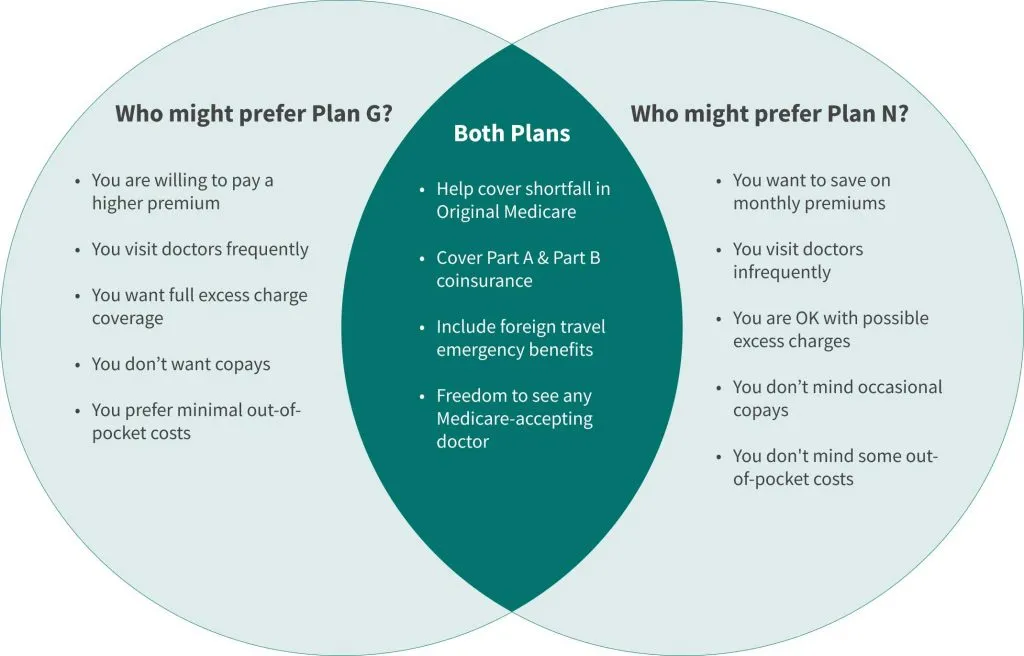
This Venn diagram compares Medicare Supplement Plan G and Plan N, highlighting their differences and shared benefits. Both plans help cover gaps in Original Medicare, include foreign travel emergency coverage, and allow you to see any Medicare-accepting doctor. Plan G is best for those willing to pay higher premiums for minimal out-of-pocket costs and no copays, while Plan N suits those who want lower premiums and don’t mind occasional copays or some out-of-pocket expenses.
Find the right Medicare supplement plan for you
Still deciding between Plan G and Plan N? Explore more Medicare supplement options using our Medicare Advice Center. This free online tool walks you through a short questionnaire to help determine which plan best fits your needs and budget.
Frequently asked questions related to Medicare supplement Plan N vs G
Q1. Is Plan G more expensive than Plan N?
Yes, but the difference is relatively minimal. Nationwide, Plan G and Plan N costs on average between $140 and $236, and $121 and $219, respectively.4
Q2. Do both plans G and N cover prescription drugs?
No. Neither Plan G nor Plan N includes prescription drug coverage. You’ll need a separate Medicare Part D plan for outpatient medications.
Q3. Are Plans G and N accepted nationwide?
Yes. Both Plan G and Plan N work nationwide wherever Original Medicare is accepted. Unlike Medicare Advantage plans, which often have network restrictions, Medicare supplement plans (like G and N) have no networks or referral requirements. You can see any doctor or specialist who accepts Medicare, anywhere in the U.S.
Q4. Can I switch from Plan N to Plan G later?
Yes, but timing matters. If you’re still in your six-month initial enrollment period, you can switch without medical underwriting. After that, switching may require health screening and insurer approval.4 Learn more about Medicare supplement enrollment with our guide.
Q5. Which plan (G or N) offers better value for money?
It depends. Plan N premiums are typically around $20 lower annually than Plan G.4 If you have fewer doctor visits, Plan N’s savings may outweigh its copays. If you prefer predictable costs or expect frequent care, Plan G may offer better long-term value.
Sources
1Medicare.gov. Learn what Medigap covers, Retrieved September 21, 2026, from www.medicare.gov/health-drug-plans/medigap/basics/coverage
2Medicare.gov. Get Medigap Basics, Retrieved September 21, 2026, from www.medicare.gov/health-drug-plans/medigap/basics
3Medicare.gov. Get Medigap Costs, Retrieved September 21, 2026, from www.medicare.gov/health-drug-plans/medigap/basics/costs
4KFF.org. Key Facts About Medigap Enrollment and Premiums for Medicare Beneficiaries, Retrieved September 21, 2026, from www.kff.org/medicare/key-facts-about-medigap-enrollment-and-premiums-for-medicare-beneficiaries/#17b02318-5705-42da-9425-0e4a9b602a59
Item #644327
Suggested content for you in Medicare
-
How to Choose the Right Medicare Supplement Insurance Plan
-
Original Medicare vs Medicare Advantage
-
Medicare Weight Loss Coverage: What You Need to Know
-
A Detailed Look at What’s Covered Under Medicare Part B
-
Breaking Down the Different Medicare Parts
-
Hospital Indemnity Insurance 101: Coverage, Costs and Key Benefits
-
Are High Deductible Medicare Supplement Plans Right for You?
-
Understanding Your Prescription Drug Plan Under Medicare Part D
-
What are the Different Medicare Supplement Plans?
-
What Is Medicare Supplement Plan F and Is It Still Available?
Explore other topics
Eating Well
Is Keto Diet Safe for Older Adults?Traveling in Retirement
Top 5 Cities for Seniors to RetireStaying Fit
5 Exercises for a Cardio Workout At Home All Categories
 Medicare
 Retirement Planning
 Business Resources
 Life Insurance
 Financial Planning
 Health & Well-Being
 Travel & Living