


Medicare Advantage vs. Medicare Supplement Insurance Plans — Which Is Right for You?



When you turn 65, and if you satisfy certain prerequisites, you are eligible to receive Medicare coverage. Many people start with Original Medicare, which includes Part A and Part B. However, this coverage, provided by the federal government, could leave you with out-of-pocket expenses. That’s because Medicare Parts A and B were designed to generally cover only 80 percent of your medical costs.
You can get additional health benefits outside of the coverage Original Medicare offers. Other types of plans, like Medicare Advantage and Medicare supplement insurance, also known as Medigap, can help cover some costs that Original Medicare does not. Both Medicare Advantage and Medicare supplement insurance plans are provided by private insurance companies that are approved by Medicare. They may help reduce your out-of-pocket costs when you receive care.
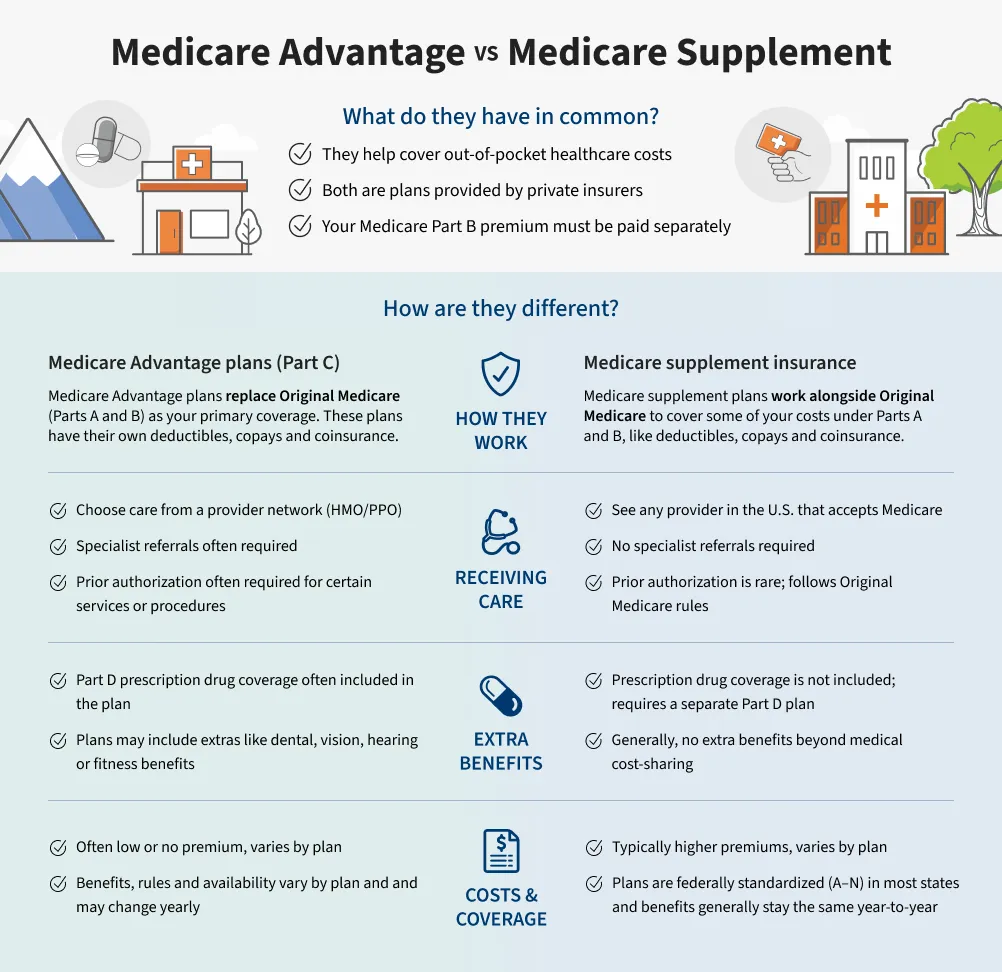
So, what’s the difference between a Medicare Advantage plan and a Medicare Supplement insurance plan? We’ve laid it out below:
Medicare Advantage plans
Also known as Medicare Part C, Medicare Advantage plans are Medicare-approved plans from private companies that provide an alternative way to get your Part A and Part B coverage, and most plans include Part D. Many plans also offer extra benefits that Original Medicare doesn’t cover, like vision, hearing, and dental.1
Things to keep in mind:
You must pay your Part B premium in addition to your Medicare Advantage premium (even if the plan premium is $0).
Many Medicare Advantage plans include prescription drug coverage, so verify that the drugs you take are covered by the plan you select.
With Medicare Advantage, you may need to use doctors and other providers in the plan’s network and service area for non-emergency care; plans may also require referrals to see specialists and prior authorization before covering certain services.
Each Medicare Advantage plan has its own deductibles, copayments, and coinsurance for covered services. These amounts differ from the cost-sharing provisions under Original Medicare.
You can enroll in a Medicare Advantage plan when you first enroll in Original Medicare, or during the annual Medicare open enrollment period (Oct. 15 – Dec. 7 each year).
Medicare supplement insurance plans
Medicare supplement insurance plans, also known as Medigap plans, are extra insurance you can buy to help pay some out-of-pocket costs that Original Medicare doesn’t cover.
Medicare supplement insurance is added alongside Part A and Part B coverage to help cover costs such as copayments, coinsurance and deductibles.
Medicare supplement plans are provided by private insurance companies, but the plan benefits are standardized by the federal government. In most states, Medicare supplement plans are labeled Plans A through N, with each lettered plan offering a specific set of benefits. (In Massachusetts, Minnesota, and Wisconsin, plans are standardized in a different way). While plan benefits are the same by company, the monthly premium and quality of customer service can vary by company.
Things to keep in mind:
Medicare supplement insurance plans typically have consistent benefits from year to year and a steady, predictable bill that you can budget for.
With Medicare supplement insurance, you can use any provider who accepts Medicare in the U.S. and don’t need referrals to see specialists. You aren’t limited to using a provider network.
Medicare supplement insurance plans don’t cover services not offered by Medicare, such as dental care or eyeglasses.
These plans don’t provide prescription drug coverage. This means you may need to enroll separately in a Medicare Part D plan for medication coverage.
If you decide to apply for a Medicare supplement insurance plan, your one-time, 6-month Medicare supplement Open Enrollment Period is often the best time to do so. During this period, you can’t be denied coverage or be charged more based on pre-existing health conditions.
Which is better: Medicare Advantage or Medicare supplement?
When considering Medicare Advantage vs. Medicare supplement insurance plans, it’s important to remember that everyone’s needs are different. When choosing a plan, think about your individual situation. Keep in mind that you can’t enroll in a Medicare Advantage plan if you already have a Medicare supplement insurance plan, and vice versa.
Factors to consider with Medicare Advantage vs Medicare Supplement:
How much is the monthly premium?
What health care and hospital services might you use often and how much will they cost with each type of coverage?
What kind of restrictions will you have on doctors, hospitals and pharmacies (e.g., does your preferred doctor accept the plan you want)?
What is the expected cost of the prescription drugs that you need regularly?
What’s the most you feel comfortable paying out of pocket at one time?
Are you comfortable with copays, and if so, how much would you want your copay amount to be for certain visits?
What might your out-of-pocket responsibility be for an unexpected hospital stay or illness?
Learn more about Medicare
Choosing a Medicare plan is an important decision, and we’re here to help. Mutual of Omaha’s Medicare Advice Center can provide a recommendation on what Medicare solution may be right for you when you answer a few simple questions about your specific needs.
Frequently asked questions
Q1. What are the disadvantages of a Medicare Advantage Plan?
While Medicare Advantage plans typically include additional benefits like dental, vision and hearing care, they can also have potential downsides that you should be aware of before you enroll. It’s important to know that Medicare Advantage plans might limit you to a specific network of doctors, hospitals, and other healthcare providers. Some plans can also require you to get a referral from your primary care doctor to see a specialist. Medicare Advantage plans can also change from year to year, so an in-network doctor you’ve been going to may not be in-network next year.
When it comes to cost, Medicare Advantage plans often have lower monthly premiums, but you may have higher out-of-pocket costs for things like copayments, coinsurance, and deductibles.
Q2. Why do people choose Medicare supplement over Medicare Advantage?
People often choose Medicare supplement over Medicare Advantage because those plans typically offer more flexibility and predictable out-of-pocket costs. Medicare supplement insurance doesn’t restrict the healthcare providers you can use. You can see any healthcare provider who accepts Medicare in the U.S., and you don’t need a referral to see a specialist.
Medicare supplement insurance plans tend to have higher monthly premiums than Medicare Advantage plans, but they help cover many of the costs not covered by Original Medicare, like copayments, coinsurance, and deductibles. This can help make healthcare expenses more predictable and manageable.
Q3. Do I still pay for Medicare Part B if I have Medicare Advantage?
Yes, you still have to pay the Medicare Part B premium even if you enroll in a Medicare Advantage plan (including plans with a $0 plan premium).1
If you are trying to decide between Medicare Advantage and Medicare supplement, it’s important to note that you can’t avoid paying a Medicare Part B premium with either plan. If you receive Social Security (or Railroad Retirement Board) benefits, your Part B premium is deducted from your benefit automatically. If you don’t, you’ll receive a bill from Medicare directly.
Sources
1 Medicare.gov. Compare Original Medicare & Medicare Advantage. Retrieved May 13, 2026, from www.medicare.gov/basics/get-started-with-medicare/get-more-coverage/your-coverage-options/compare-original-medicare-medicare-advantage
2 Centers for Medicare & Medicaid Services. (2020, August 19). Allow End Stage Renal Disease (ESRD) beneficiaries to enroll in Medicare Advantage (MA) and Medicare Advantage Prescription Drug (MAPD) plans. Retrieved May 18, 2026, from www.cms.gov/files/document/allow-end-stage-renal-disease-esrd-beneficiaries-enroll-medicare-advantage-and-medicare-advantage.pdf
376401_0626
Suggested content for you in Medicare
-
How to Choose the Right Medicare Supplement Insurance Plan
-
Medicare Durable Medical Equipment Coverage
-
Medicare Weight Loss Coverage: What You Need to Know
-
Original Medicare vs Medicare Advantage
-
Breaking Down the Different Medicare Parts
-
Hospital Indemnity Insurance 101: Coverage, Costs and Key Benefits
-
Are High Deductible Medicare Supplement Plans Right for You?
-
Medicare Supplement Plan G vs. Plan N: Which One’s Best for You?
-
Understanding Your Prescription Drug Plan Under Medicare Part D
-
What are the Different Medicare Supplement Plans?
Explore other topics
Traveling in Retirement
Top 5 Cities for Seniors to RetireStaying Fit
5 Exercises for a Cardio Workout At HomeHealth & Aging
Fun Activities for Seniors to Stay Healthy All Categories
 Medicare
 Retirement Planning
 Business Resources
 Life Insurance
 Financial Planning
 Health & Well-Being
 Travel & Living