0:02
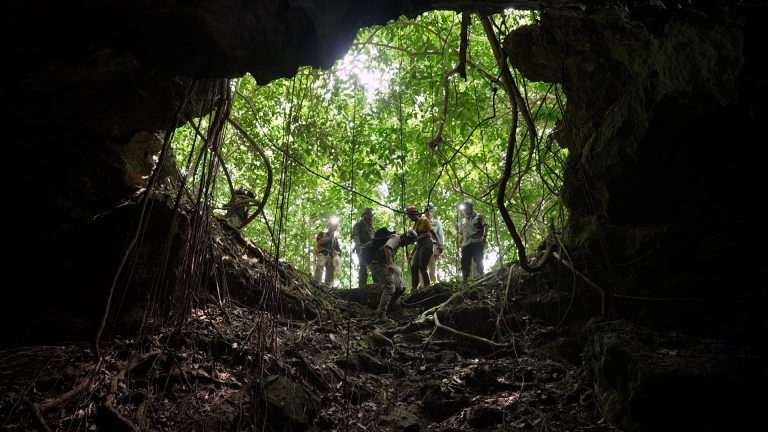
Look up in the forest of Costa Rica and you'll discover another world, a thriving community that spends their lives in the treetops.
0:11
Scientists call them arboreal species, sloths, monkeys, porcupines, kinkajous and almost 1000 bird species.
0:22
Just a generation ago, much of this country had been cleared for ranches and farms.
0:27
But today, thanks to bold policies and decades of restoration, more than 1/4 of Costa Rica's territory is set aside for conservation.
0:37
Success brings new challenges.
0:39
As wildlife returns alongside growing communities, treetop travelers encounter new obstacles they've never evolved to navigate.
0:49
But at places like the Tucan Rescue Ranch in the Highlands in the town of San Jose, CITO, a network of veterinarians, volunteers and innovators is keeping Costa Rica's conservation legacy alive.
1:03
Hi there.
1:04
Hey, I'm Ray.
1:05
Are you Doctor Andres?
1:06
I'm Doctor Andres.
1:06
Welcome.
1:07
Thank you so much.
1:08
It's amazing to be here.
1:09
What a place.
1:10
Founded in 2004, Toucan Rescue Ranch has rescued, rehabilitated and whenever possible, returned thousands of animals back to the wild.
1:20
This morning's first patient is an orphaned baby sloth named Lucretia.
1:26
Oh, it's like, impossibly cute.
1:29
Yes, Doctor Andres treats dozens of babies every year who've lost their parents to one of the greatest threats facing arboreal wildlife Electrocution.
1:40
Very, very many sloths and very, very many animals overall come to us each year because of electrocution.
1:46
Essentially speaking, power lines become easy access for animals to try to move between patches of rainforests that have now become separated from each other.
1:55
We don't believe that there's anything wrong with the baby, but it happens sometimes that mothers may get electrocuted.
2:01
And So what we do here is we just recover those babies and we try to get them out into the wild.
2:06
The first thing I'm noticing is that it's clinging to a stuffed animal sloth, correct?
2:11
Sloths, when they're born, they're very, very attached to their mothers.
2:15
It still needs a little bit of that sense of companionship.
2:18
So right now we have this puppet, and in the inside of the puppet there's a heart simulator.
2:22
So it's like a little heart.
2:24
Oh, so the baby can actually feel a heartbeat like this is its mother.
2:28
Exactly.
2:28
Wow.
2:29
What age would you imagine this sloth is?
2:31
So this sloth is 100% less than a week old.
2:35
Wow.
2:35
And So what we're going to be working with is we're just going to give her a quick little check up.
2:39
We want to make sure that there's no injuries hiding under that fur.
2:44
She looks fine to me.
2:46
After recovering here, Lucretia will go to a sanctuary for about a year before she'll be returned to the wild, close to where she was born.
2:55
Bye bye Lucretia.
2:57
For some wildlife, a power line strike means losing a parent.
3:02
Others survive but face months of treatment.
3:05
Hello there.
3:06
She's a beauty, right?
3:07
She have a name yet?
3:08
Yes.
3:08
So her name is Joy.
3:10
Both Joy and Lucretia are two toed sloths.
3:14
For them, the canopy is home, a source of food and a route through the treetops, all in one slow moving world above the forest floor.
3:23
Two toed sloths are famously aggressive, so we give Joy anaesthesia, both to calm her down and so she isn't feeling any pain.
3:32
Ready.
3:33
Yep, 123.
3:36
Perfect.
3:37
Once she's sedated, we move her to the exam table.
3:41
Fur is an excellent place for injuries to hide without me actually being able to see it.
3:48
Did you find something?
3:49
Yeah.
3:49
So here's her first indication that something might be going on.
3:53
So this is a very, very superficial burn.
3:55
There's another one on this side as well.
3:57
All of these are clues of electrocution.
3:59
What about the face?
4:00
Because her face looks injured and then her eyes are white, which means possible blindness.
4:05
Yes, but it's not around the pupil.
4:08
I can still see the pupil.
4:08
Well, so right now, she probably cannot see at all, but that is probably going to scar up and she's going to regain some of her vision.
4:17
Doctor Andres is cautiously hopeful Joy will recover and someday be released back to the wild.
4:23
But for conservationists in Costa Rica, saving injured animals like Joy is only half the mission.